Circle Area Calculator: Formulas, Examples, and Applications
Calculate a circle's area from its radius, diameter or circumference, with formulas, worked examples, squared units and common mistakes explained.
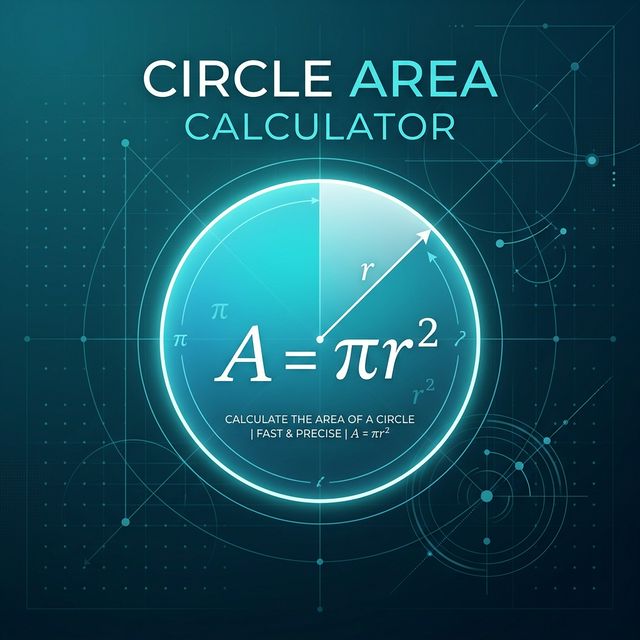
The area of a circle is the amount of flat surface inside its edge. Use the calculator below to get it from the radius, the diameter or the circumference, then read on for the formulas, worked examples and common mistakes.
Choose what you measured, enter the value and pick a unit. The area appears instantly in square units. If you only need to turn a circumference into a diameter, use the circumference to diameter calculator instead.
Circle Area Calculator
Enter a positive number to see the area.
Circle Area Formula
The standard formula uses the radius, the distance from the centre to the edge:
A = πr²
- A is the area
- π ≈ 3.14159
- r is the radius
Because the radius is squared, area grows quickly: double the radius and the area becomes four times larger.
Example: area from radius
Radius r = 7 cm: A = π × 7² = π × 49 ≈ 153.94 cm².
Area from Diameter
The diameter is twice the radius, so halve it first, or use the equivalent form:
A = π(d/2)² = πd²/4
Example
Diameter d = 20 m: r = 10 m, so A = π × 10² ≈ 314.16 m². If you need the radius on its own, the diameter to radius calculator handles that step.
Area from Circumference
When only the distance around the circle is known, combine C = 2πr with A = πr²:
A = C² / 4π
This avoids rounding the radius along the way. If you need the radius separately, use the circumference to radius calculator.
Example
Circumference C = 50 in: A = 50² / (4π) = 2500 / 12.566 ≈ 198.94 in².
Why Area Units Are Squared
Area measures a surface, so its unit is a length multiplied by a length:
- cm → cm²
- m → m²
- in → in²
- ft → ft²
Convert lengths before you calculate rather than converting the area afterwards: 1 m = 100 cm, but 1 m² = 100 cm × 100 cm. Likewise 1 ft = 12 in, so 1 ft² = 144 in².
Common Circle Area Mistakes
- Using the diameter as the radius. The result is four times too large. Halve the diameter first.
- Forgetting to square the radius. π × r is not an area; π × r² is.
- Mixing units. A radius in centimetres gives an area in cm², not m². Keep every length in the same unit.
- Rounding π too early. For r = 20 m, 3.14 × 400 = 1256 m², while π × 400 ≈ 1256.64 m². Keep full precision until the last step.
Real-World Examples
Round table
A table 1.2 m across has r = 0.6 m, so its top covers about 1.13 m².
Pizza
A 12-inch pizza has about 113.1 in² and a 16-inch pizza about 201.06 in², roughly 1.78 times as much pizza for a size only a third larger.
Circular garden bed
A bed with a 3 m radius covers about 28.27 m², which helps when estimating soil, mulch or seed.
Pipe cross-section
A pipe with a 5 cm inside diameter has an open area of about 19.63 cm², the space the flow passes through.
Quick Reference Table
| Radius | Diameter | Area |
|---|---|---|
| 1 | 2 | 3.14 |
| 2 | 4 | 12.57 |
| 5 | 10 | 78.54 |
| 10 | 20 | 314.16 |
Frequently Asked Questions
How do you calculate the area of a circle?
Square the radius and multiply by π: A = πr². From a diameter use A = πd²/4, and from a circumference use A = C² / 4π.
Should I use 3.14 or π?
Use the full value of π where you can. 3.14 is fine for rough estimates, but it is about 0.05% too small.
Can I get the radius back from the area?
Yes: r = √(A / π). For example, an area of 78.54 cm² gives r ≈ 5 cm.
Related Circle Calculations
To see why π links every circle's circumference to its diameter, read why the ratio of circumference to diameter is π. For the history and properties of the constant itself, see what is pi.